

The four things about perimenopause bloating that nobody told me.

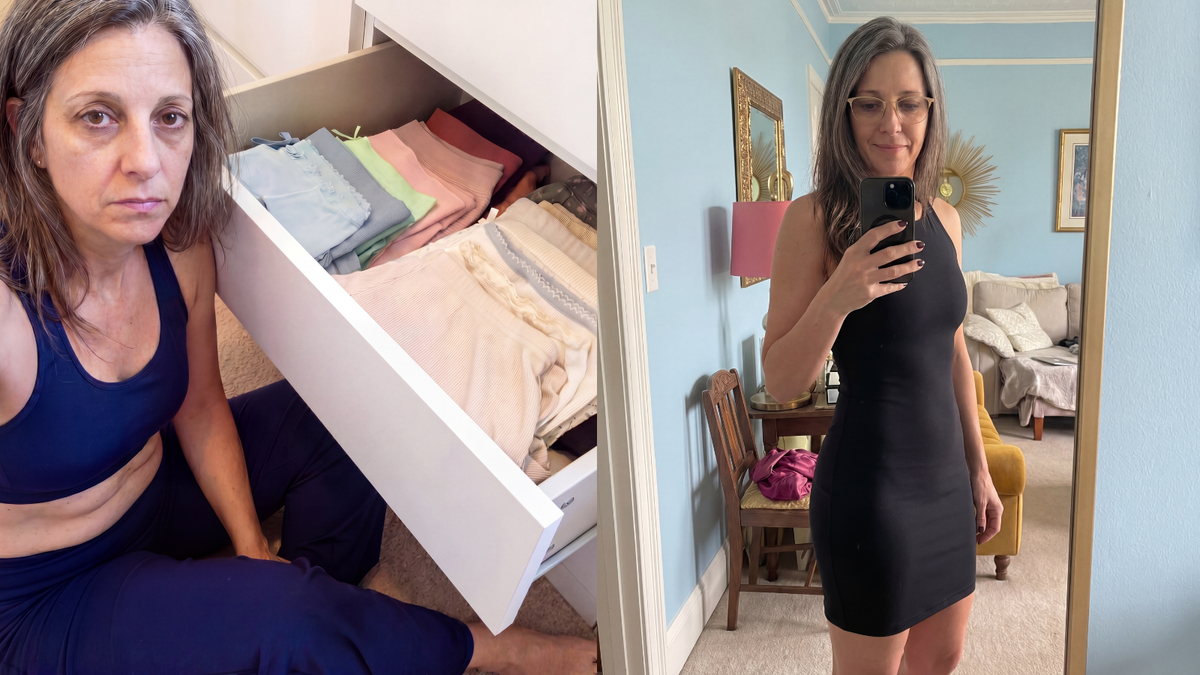
This is my own story. I wrote it because I wish someone had handed me this article a year ago.
If you saw the post about the drawer of pants I only wear after 4pm, this is the rest of the story.
I'd been bloating every afternoon for almost two years before I figured out what was actually happening. I'd tried probiotics, elimination diets, a 30-day FODMAP, and asking my doctor twice. None of it had worked.
I went down a rabbit hole the night Emma's sister told me what was actually happening to my body. I started Googling at 11pm and got to bed at 4am. What I found that night is the article below.
Four things. The order they're in is the order I figured them out.
*Editorial note
What perimenopause bloating actually does to your body
- Disrupts how your body clears estrogen, leading to lingering hormone levels even as estrogen declines¹
- Slows digestion every hour you're awake, which is why bloat builds across the day
- Damages the gut microbiome over time, making the cycle harder to break the longer it goes on²
- Erodes self-confidence, social life, and quality of life — not because of vanity, but because women shrink their world to hide it
But what if the bloating wasn't actually a digestive problem at all?
That's what I didn't understand until 1am the night I went down the rabbit hole. The bloat I'd been treating as a stomach issue was actually a hormone-clearance issue showing up in my stomach. Once I understood that, everything else fell into place.
Here's what I figured out, in order.
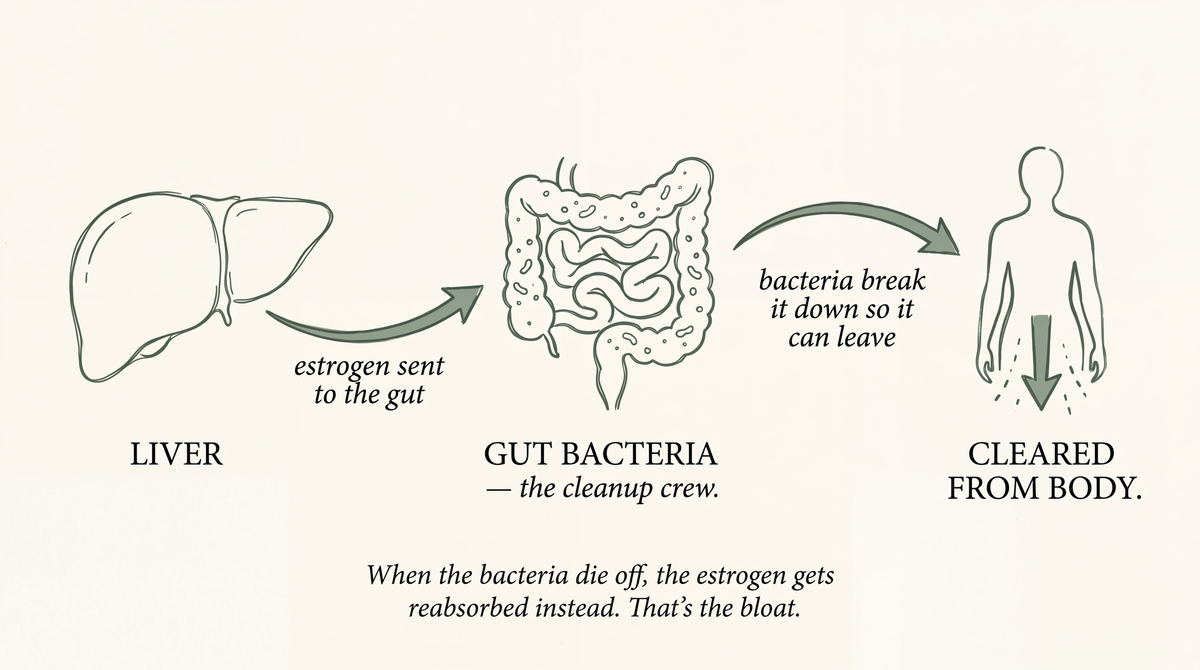
The four things I figured out about perimenopause bloating.
Most women in their 40s deal with some version of the daily bloat cycle. Most of them never figure out the cause because nobody is taught any of this in school, in doctor's offices, or anywhere else. These four things took me a while to find. Here they are in one place.
#1 My stomach was never the problem.
I'd spent two years thinking my stomach was broken. The first thing I figured out at 1am was that my stomach was completely fine.
The estrobolome is real. It's not a wellness term. It's the colony of bacteria in your gut that processes estrogen — specifically, the version your liver has already broken down and is trying to clear out of your body. You can Google it. There's research from Harvard, the Cleveland Clinic, and the Mayo going back to the early 2010s.
When the bacteria are healthy, this all happens quietly in the background. When they start dying off — which is what happens to most women in their 40s — the cleanup stops working. The estrogen sits. Your gut slows down because it's now dealing with a hormone disruption it didn't sign up for.
That slowing is what creates the bloat. It's not a digestive symptom. It's a hormone-clearance symptom that happens to show up in your stomach.
I'd spent two years treating a hormone problem like a food allergy. 😔

#2 Every probiotic I'd ever bought had failed me for the same reason.
After I understood what the estrobolome was, I went into my kitchen and pulled out every probiotic I'd taken in the last two years. Six bottles. About $300 worth. None of them had moved the needle on the bloating.
By 2am I'd figured out three rules that explained why none of them had worked. You can run them on any probiotic you have on a shelf right now.
1️⃣ Most probiotics don't survive your stomach acid. Without a delivery system that protects the bacteria, they're dead before they reach your gut.
2️⃣ Most probiotics use lab-grown strains, not the food-derived ones your estrobolome actually needs. Different bacteria. Different job.
3️⃣ Most probiotics don't include a food source for the bacteria they deliver. So the bacteria pass through in a couple of days and you're back where you started.
If your probiotic doesn't address all three, that's probably why it didn't work. That was true for all six of mine.

#3 The thing I'm most embarrassed about.
Once I understood that bacteria need food to colonize, I had a moment in my kitchen that I'm not proud of.
I'd been on increasingly restrictive elimination diets for over a year. Cut dairy. Cut gluten. Did a thirty-day FODMAP. Cut nightshades. Cut anything raw, then anything cooked in oil, then about twenty-three other things along the way.
I'd been keeping a list inside my kitchen cabinet of foods I was "investigating." It got to 16 items. I didn't tell anyone about it.
And here's the embarrassing part. Every single food I'd been removing from my diet was a food the bacteria I needed could've been feeding on.
I'd been starving the exact thing I needed to rebuild. My body had been trying to fix itself, and I'd been working against it for a year. 🫠
If you've been on an elimination diet for months and the bloating is still getting worse, the food was never the problem. Food is what your gut uses to repair. You can't repair a system by removing the building materials.

#4 Nothing about the recovery is fast.
The fourth thing I figured out is the most important one if you're going to actually do something about this. The wrong expectations are how most women give up before any of this works.
Bacteria multiply in cycles. You can't replenish a colony overnight any more than you can grow back hair overnight or rebuild muscle overnight. The biological cycle for re-establishing a stable gut microbiome is about 84 days. Three months. That's how long the process actually takes.
In practice: week one, nothing. Week two, maybe still nothing, and you'll question your decision. Week three, a small thing. A pair of pants that fits at 4pm. A meal that doesn't make you panic. By month three, you'll realize it's been a while since you've had a really bad day.
I know this is the opposite of what every supplement ad on the internet promises. They all promise results in two weeks because that's when the credit card refund window closes.
The truth is rebuilding takes a season, not a weekend. If you're not willing to give it three months, none of this is going to work.

These four things combine into one practical decision: find a probiotic actually built for the estrobolome, give it three months, and stop blaming the food.
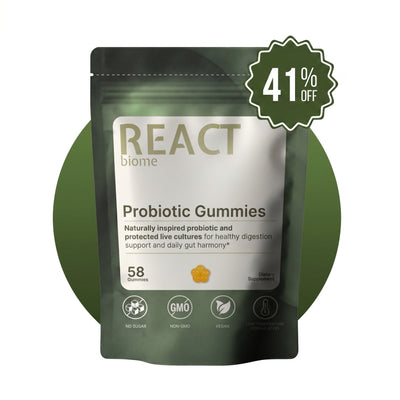
I tried what Emma's sister recommended. Here's what was actually in it.
What makes React Biome different from other probiotics.
It's hard to believe that with all the gut-health products on the market, this would be the one that actually targets perimenopause bloating. Until you understand the science behind the estrobolome.
Most probiotics on the market today were designed in the 1990s and 2000s, before researchers even knew the estrobolome existed. They use generic strains and basic delivery, and that's why they don't move the needle on hormone-related bloat.
React Biome is different because it's built around a three-part formula that addresses the three rules I laid out above. Not one of them. All three.
MicroShield delivery. A protective layer engineered specifically for stomach acid. Most probiotics lose 90%+ of their bacteria in the stomach. MicroShield is what gets the bacteria to your gut alive.
Food-Inspired Strains. Bacteria sourced from fermented foods — the way your gut evolved to receive them. Not lab-grown lactobacillus and bifidobacterium that other probiotics use because they're cheaper to manufacture.
Cranberry Duplibiotic. A built-in food source so the bacteria can actually colonize once they arrive, instead of passing through in a couple of days.
Three things working together. Most probiotics have one. Some have two. This is the only one I found with all three.
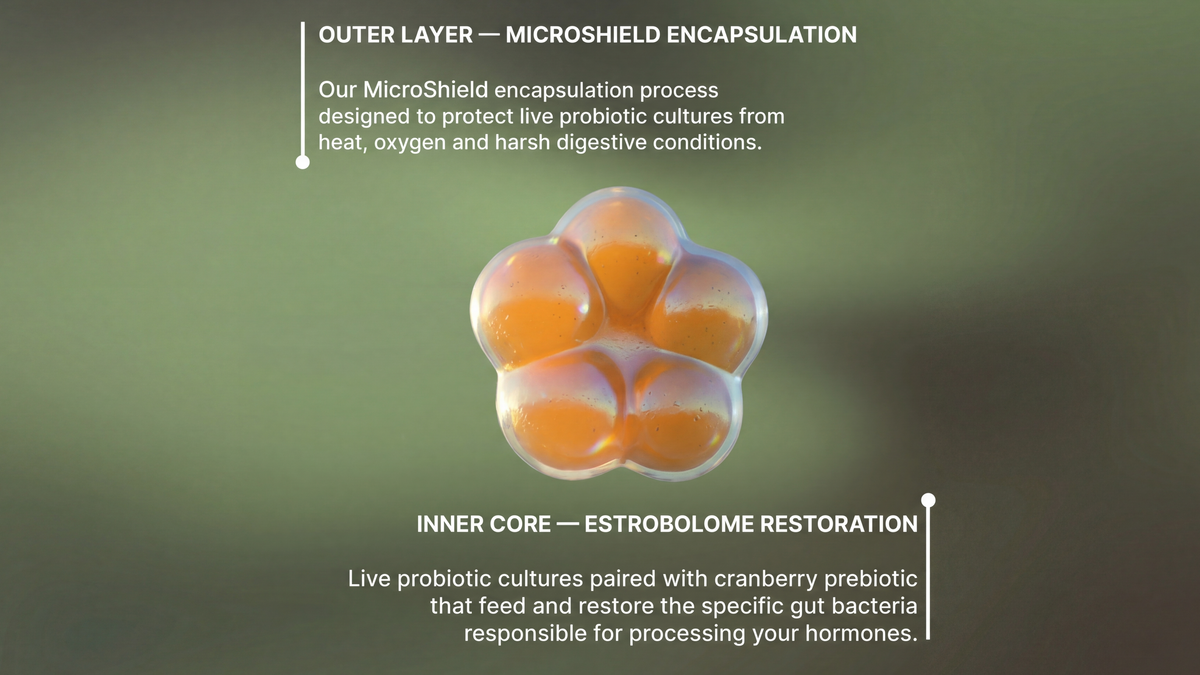
Unlike standard probiotics that lose most of their bacteria in your stomach, React Biome uses MicroShield to deliver the bacteria where they need to go. The food-derived strains are the ones your estrobolome is built around. The cranberry duplibiotic is what lets them stay.
This is why most women notice the daily bloat cycle starts settling around week three, and why it takes until about month three to really stabilize. The biology takes time. The protocol works with it instead of against it.
Two gummies. Every morning. That's the whole protocol.
Ready to fix your bloating?
What I take >>>>
Don't keep the drawer.
If you've been bloating every afternoon for years, telling yourself it's stress, it's age, it's something you ate — you aren't imagining it.
It has a name. It has a cause. And it isn't your fault.
The cause is your estrobolome. The name is perimenopause. And no diet you try is going to fix it. The food was never the problem.
If you want to give the protocol a real try, the only ask is that you give it three months. That's how long the rebuild takes. Anything less and you're not testing the product, you're testing your patience.
— Meredith 💚
Reference List:
- Plottel CS, Blaser MJ. "Microbiome and Malignancy." Cell Host & Microbe. 2011;10(4):324-335.
- Baker JM, Al-Nakkash L, Herbst-Kralovetz MM. "Estrogen–gut microbiome axis: Physiological and clinical implications." Maturitas. 2017;103:45-53.
- Peters BA, Lin J, Qi Q, et al. "Menopause Is Associated with an Altered Gut Microbiome and Estrobolome." mSystems. 2022;7(3).
- Schreurs MPH, de Vos van Steenwijk PJ, Romano A, et al. "How the Gut Microbiome Links to Menopause and Obesity." Journal of Clinical Medicine. 2021;10(13).
Limited Time: 41% Off
60-Day Satisfaction Guarantee